What Kind of Gravel Goes Under a Shed? A Concrete Guy's Straight Answer
You bought a shed, the delivery date is on the calendar, and now you're on a stone supplier's website at 11 at night trying to figure out what "#57" means and whether pea gravel is fine because it's cheap and looks nice. This question comes up all the time, so here's the straight version.
Use crushed, angular stone. Not round stone. After that, picking between clean stone and crusher run comes down to your yard, and I'll walk you through how I make that call.
Why Round Stone Is the Wrong Stone
Pea gravel and river rock are smooth. Put weight on smooth stone and it rolls, the way a pile of marbles would. Under a shed, that means the corners slowly sink and drift, the floor goes out of level, and one spring the door won't latch.
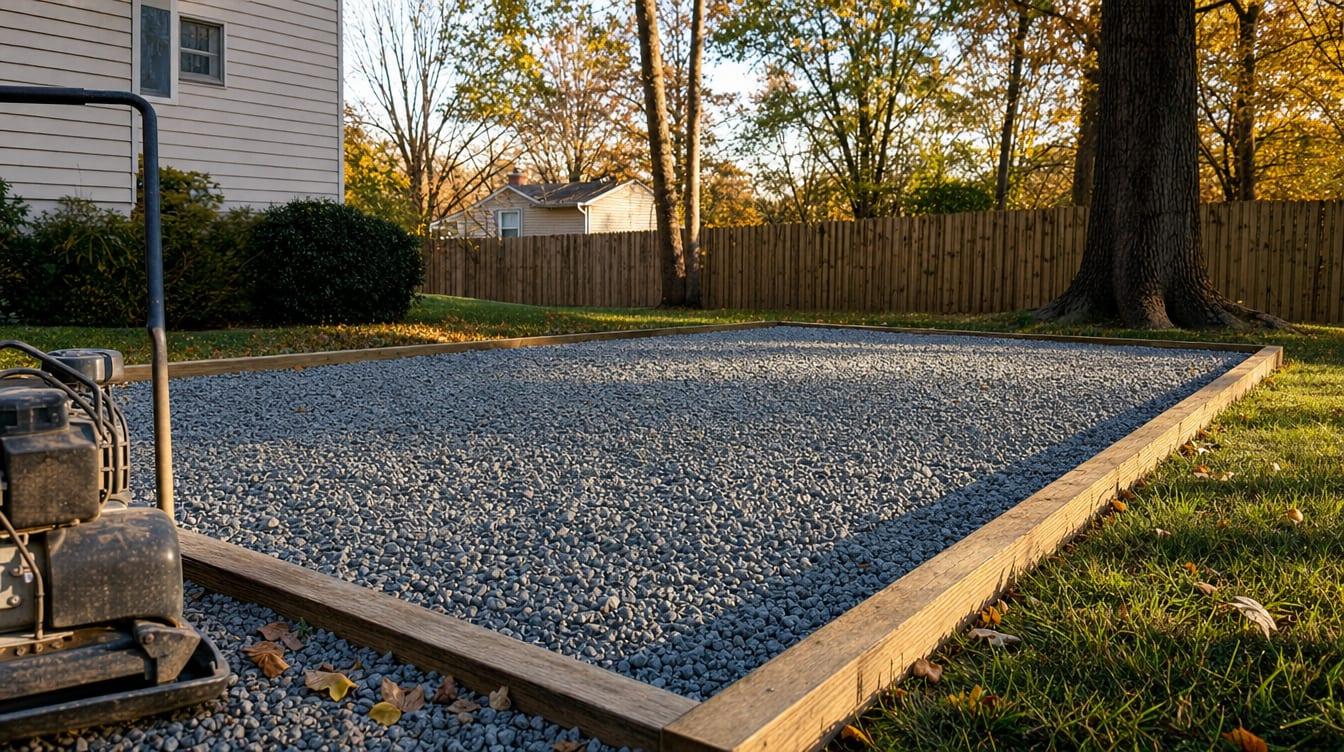
Crushed stone gets broken up by a machine, so every piece has sharp faces and edges. When you compact it, those edges bite into each other and lock. A gravel pad holds a shed up because the pieces are wedged together.
People ask me about the cheapest gravel for a shed base. The cheapest stuff at most yards is the round decorative stone, and it's exactly what you don't want. Saving a couple hundred bucks on stone and redoing the pad in three years isn't a deal.
The Three Stones You'll Hear About
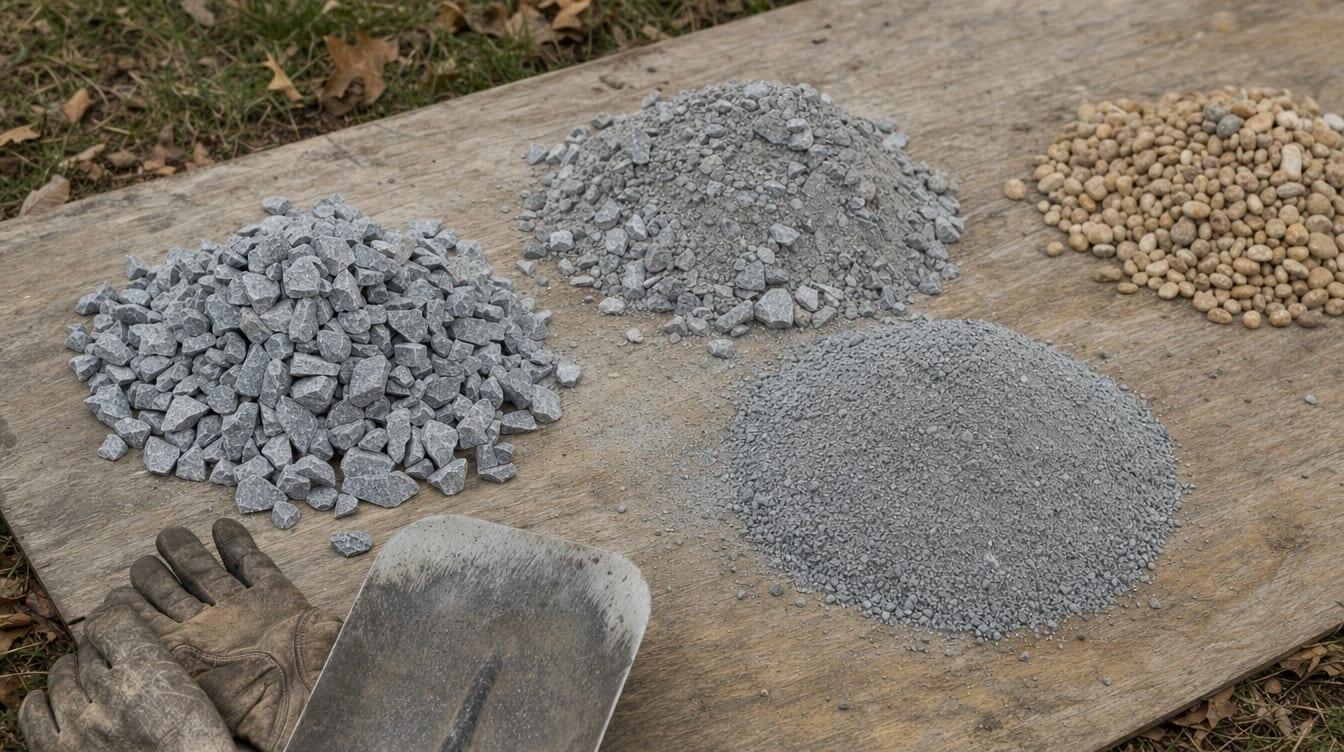
Clean Crushed Stone (#57)
#57 is crushed stone that runs roughly three quarters of an inch to an inch, washed so there's no dust or fines in it. With nothing filling the gaps between pieces, water runs straight through. That's what it's good at.
The tradeoff is the surface. Without fines it won't pack into a hard, smooth top the way a mixed stone will. Compacted and held inside a frame, it locks up fine, but it can feel a little loose underfoot.
Crusher Run (CR-6)
Around here you'll hear it called CR-6, crush and run, or crusher run. Same stuff. It's crushed stone mixed with the dust and small pieces left over from crushing. Wet it and compact it and those fines fill every gap, so it sets up almost as hard as a road base. That's why it ends up under so many driveways.
The tradeoff runs the other way. With the gaps filled in, water moves through it slower than it moves through clean stone.
Stone Dust (Screenings)
Stone dust is the fine leftover from crushing, basically coarse gray sand. Some people like a thin layer on top because it's smooth and easy to level. A thin layer is fine. A thick one holds water and goes soft, so it's a finishing layer at most and never the pad itself.
So Which One Goes Under Your Shed?
I can't tell you that from a blog post, because it depends on the yard. When I'm standing in your backyard, this is what I'm looking at:
- Where the water goes. Most of Anne Arundel County sits on clay, and clay holds water. If your shed spot is low, or the yard sheds water toward it after a storm, drainage jumps to the top of the list.
- How level the ground is. A sloped spot needs more stone on the low side and a frame strong enough to hold it.
- What's going inside. A few rakes and a push mower is one load. A riding tractor or a bench full of heavy tools is another.
- The shed itself. Some shed companies spell out what they want under their buildings. If yours does, we start there.
Sometimes all that adds up to clean stone, sometimes crusher run, and sometimes layers of both. I'd rather make that call looking at your dirt than guess at it from a stone yard price list.
The Stone Is Only Half the Pad
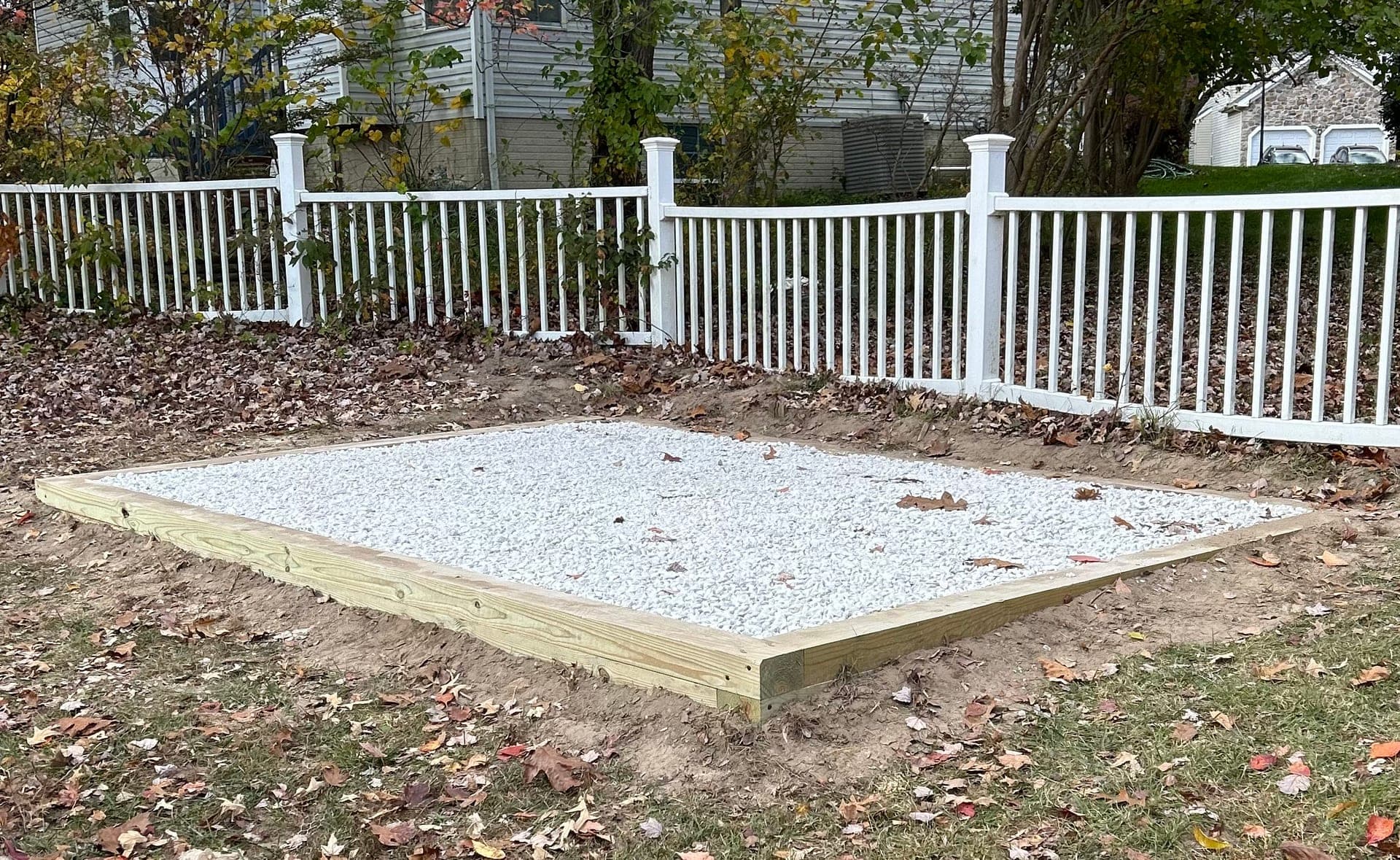
People spend a lot of time on the type of gravel and skip the steps that matter just as much. Perfect stone dumped on top of grass will still fail. Here's how we build a pad, start to finish:
- Dig out the soft stuff. We excavate, typically 6 to 8 inches, and strip out the topsoil and anything organic. Grass and roots rot, and anything that rots settles.
- Grade the bottom. We shape the subsoil so water moves away instead of pooling under your shed.
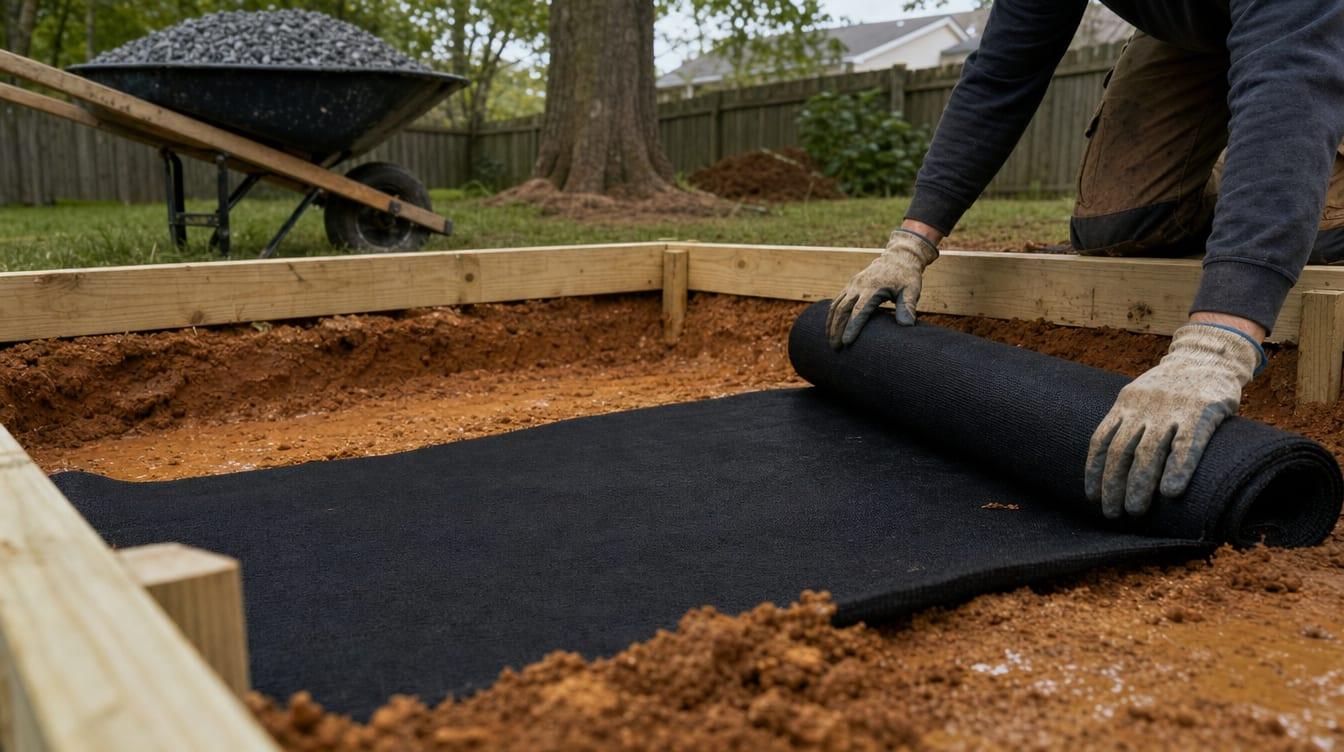
- Lay geotextile fabric. The fabric keeps the clay from pushing up into the stone and the stone from sinking down into the clay. It helps keep weeds out too.
- Frame it. A frame holds the stone in so the edges don't spread under the weight.
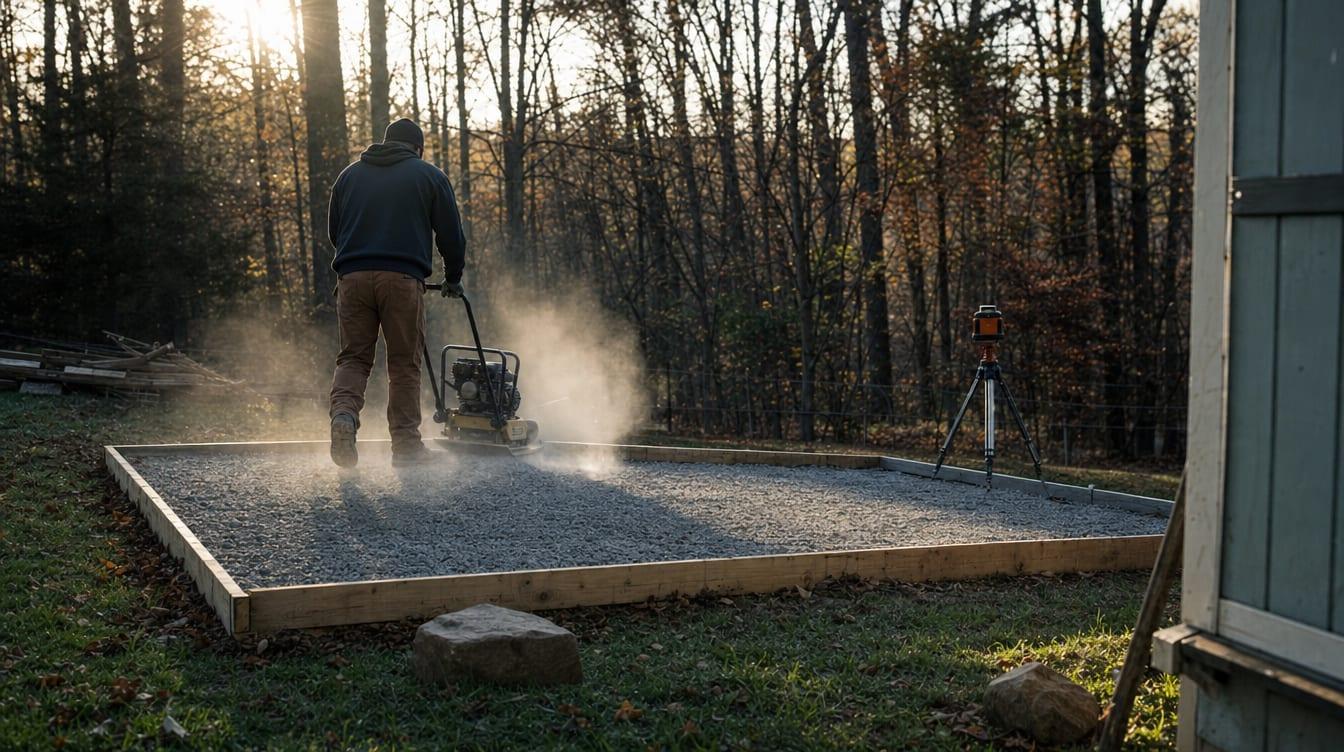
- Add stone in layers and compact every one. We run a plate compactor over each lift instead of dumping it all at once and hoping. Most of our pads end up 4 to 6 inches of compacted crushed stone, and we go up to 8 for heavier buildings or soft ground.
- Laser level it. Close enough to level will show up later in your shed doors.
Skip any of those and the type of stone barely matters. I go deeper on the digging and water side in my post on excavation, grading and drainage.
How Big, and How Much Stone?
Build the pad bigger than the shed. A common rule, and a good one, is about a foot past the walls on every side. The extra stone catches rain coming off the roof so it doesn't dig a trench along the base, and it gives you a dry spot to step onto when you walk out the door.
For a rough idea of how much stone that takes: one cubic yard covers about 80 square feet at 4 inches deep. An 8x10 shed on a 10x12 pad is 120 square feet, which works out to a little under a yard and a half at 4 inches, or roughly two tons of stone. Go deeper and the number climbs fast. Every yard is different, so use that as a ballpark and not as an order.
Should It Be Gravel at All?
For most backyard sheds I think a well-built gravel pad is the right call. It drains, it goes in faster, and the shed can sit on it right away. If you're putting up something heavy, like a garage-style building or a workshop, concrete might make more sense. I laid out gravel pads and concrete slabs side by side if you're stuck between the two.
My Two Cents
Everybody asks about the gravel, but a pad lives or dies on the dig, the fabric, the frame and the compaction. Get those right and clean stone or crusher run will both hold your shed level for a long time. Get them wrong and no stone in the world will save it.
We build gravel pads and shed foundations for homeowners in Odenton, Crofton, Pasadena, Glen Burnie and the rest of Anne Arundel County, and I'm licensed (MHIC #05-163777). If you've got a shed on the way, see how we build pads or grab a free estimate. I'll come walk the spot with you and tell you what I'd put under it and why.
Bobby
Owner & Lead Contractor at Backyard Bobby's
Bobby is a licensed outdoor construction contractor (MHIC #05-163777) based in Millersville, Maryland. He and his crew have completed hundreds of projects across 19 Anne Arundel County communities — from gravel pads and patios to full deck builds and accessory dwelling units. When he's not on a job site, he writes about what Maryland homeowners should know before starting their next outdoor project.
Ready to Get Started on Your Gravel Pads & Concrete Foundations Project?
We provide free estimates for all gravel pads & concrete foundations projects in Anne Arundel County and surrounding areas.